
PVD vs Electroplating: What a Hardware Finish Name Does—and Does Not—Tell You
Colour is not a coating specification. Understanding the substrate, intermediate layers and surface texture makes decorative hardware finishes easier to compare.
Gold and silver are colours, not processes
A gold-coloured handle might prompt a discussion about PVD, while a silver one is often casually described as chrome. Neither observation establishes the complete finish construction. Colour is the visible result; the material underneath and the route used to create that surface are separate questions. A photograph is particularly poor evidence because lighting and reflected surroundings can change the apparent hue.
Oerlikon's process descriptions distinguish electroplating, which deposits metal electrochemically, from physical vapour deposition, or PVD, which forms a thin coating through a vacuum deposition process. That distinction describes how a layer is made. It does not, on its own, identify every layer in a finished handle or establish which article will last longer in a particular environment.
A finish can combine processes rather than choose one
The phrase 'PVD versus electroplating' can suggest two mutually exclusive products. In practice, a decorative surface may be a layered system. KOHLER provides an example from fittings: its description of a particular PVD finish includes a nickel undercoat. This is a useful illustration of layered construction, not a specification for all PVD-coated door or window hardware.
The comparison therefore needs to move from a single label to a sequence: base material, surface preparation, intermediate layers, decorative coating and any specified protective treatment. Not every system contains the same stages. A claim about the outermost layer does not tell the reader how well the underlying material was prepared, or how the complete stack behaves at edges and detailed features.
A thin coating does not erase the surface underneath
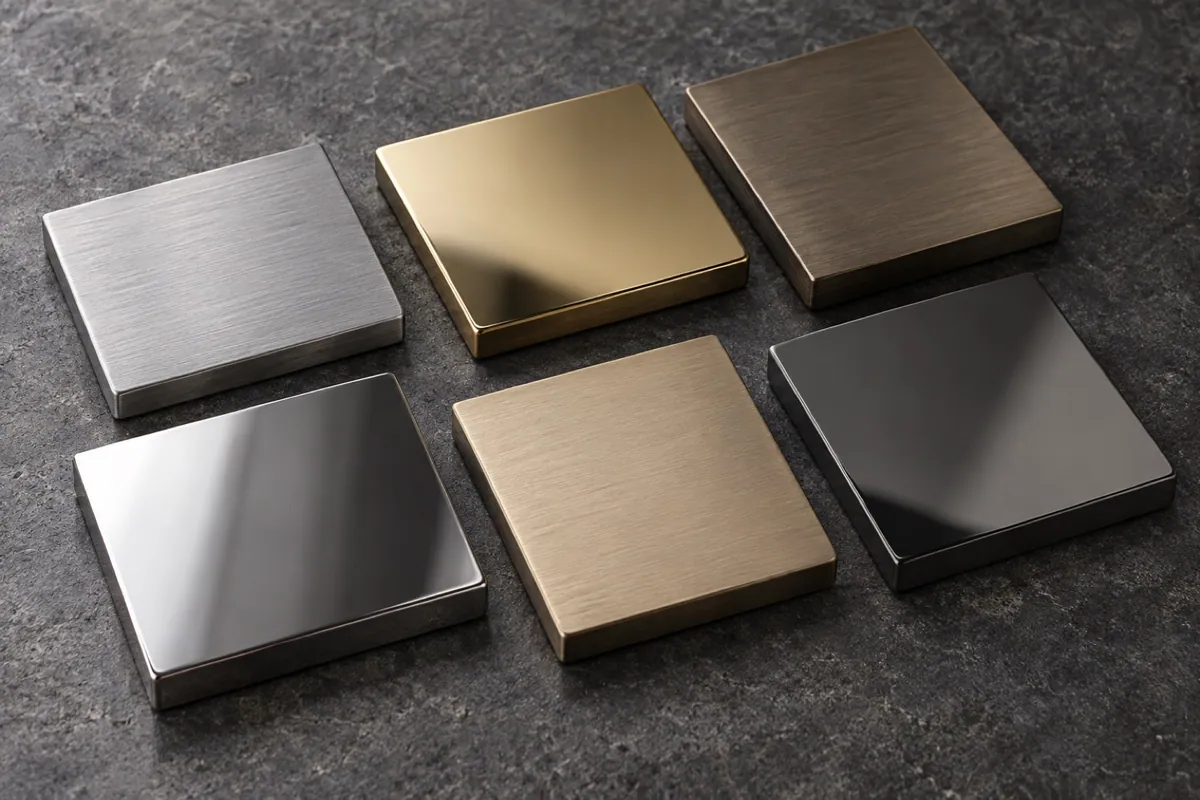
Texture explains why two nominally similar colours can look very different. Oerlikon Balzers notes that a thin PVD layer reproduces the underlying surface structure. A brushed base and a highly polished base can therefore produce different visual results even within a related colour family. Reflection, rather than pigment-like colour alone, is a large part of the appearance.
This matters when matching a lever, backplate and hinge. Their different shapes reflect different parts of the room, while brushing direction adds another visual variable. Placing physical samples together under the intended lighting is more informative than comparing isolated catalogue images. A satisfactory match is an observation about the finished components, not proof that they share an identical process.
Scratch resistance is not the same question as corrosion resistance
A claim about resistance to scratching concerns one type of damage. Wear through repeated contact, adhesion between layers and corrosion in a particular exposure describe other questions. One favourable result cannot silently answer all of them. The useful evidence states the test method, specimen construction, exposure conditions and acceptance criteria, rather than presenting an impressive adjective alone.
The same caution applies to comparisons between different substrates. A coating result obtained on one prepared base does not automatically describe another base with different intermediate layers. HOPPE discusses PVD within architectural ironmongery finishes, but that broad category description is not a substitute for performance information about a specific finished component. Process names help organise a comparison; they do not finish it.
A realistic finish match needs a shared viewing condition
Imagine a brushed champagne lever next to a polished champagne escutcheon. Under diffuse daylight they may appear close; under a narrow overhead light one can look much brighter. That hypothetical mismatch is not automatically a defective coating. Texture, curvature and the illumination can make a coordinated set look different from a collection of flat swatches.
A reference sample becomes more useful when its texture and viewing conditions are recorded alongside its colour name. This also prevents terms such as 'satin', 'brushed' or 'antique' from being treated as universally fixed appearances. The sample establishes a visual reference; any numerical colour tolerance or performance requirement still needs its own stated measurement method.
A process label is not a complete environmental assessment
It is tempting to infer a complete environmental ranking from the deposition stage alone. That comparison leaves out other parts of production. Surface preparation, intermediate treatments, process energy, consumables and service life all affect the boundary of the question. This is a boundary-setting observation, not a life-cycle calculation showing that either route is always preferable.
A substantiated environmental statement needs to say what was compared and what was excluded. A factory-level process improvement, a coating-stage claim and a whole-product assessment are different kinds of evidence. Keeping those categories separate avoids turning a limited technical advantage into a much larger claim than the supporting information can carry.
Compare the finished system, then interpret the label
For decorative door and window hardware, the most useful description combines the base material, finish stack, surface texture, agreed visual reference and relevant performance evidence. Those details explain far more than a colour name accompanied by the word PVD or electroplated.
Neither process name guarantees an indistinguishable colour match, universal corrosion resistance or freedom from wear. Understanding the construction does not make the choice unnecessarily complicated; it makes the comparison more precise. The visible surface is the end of a manufacturing sequence, and its quality cannot be understood by naming only the final step.