

Why a Casement Window Crank Gets Harder to Turn
A stiff crank is not automatically a failed gearbox. The point at which resistance appears can reveal more than the shape of the handle.
The crank is an input, not an isolated mechanism
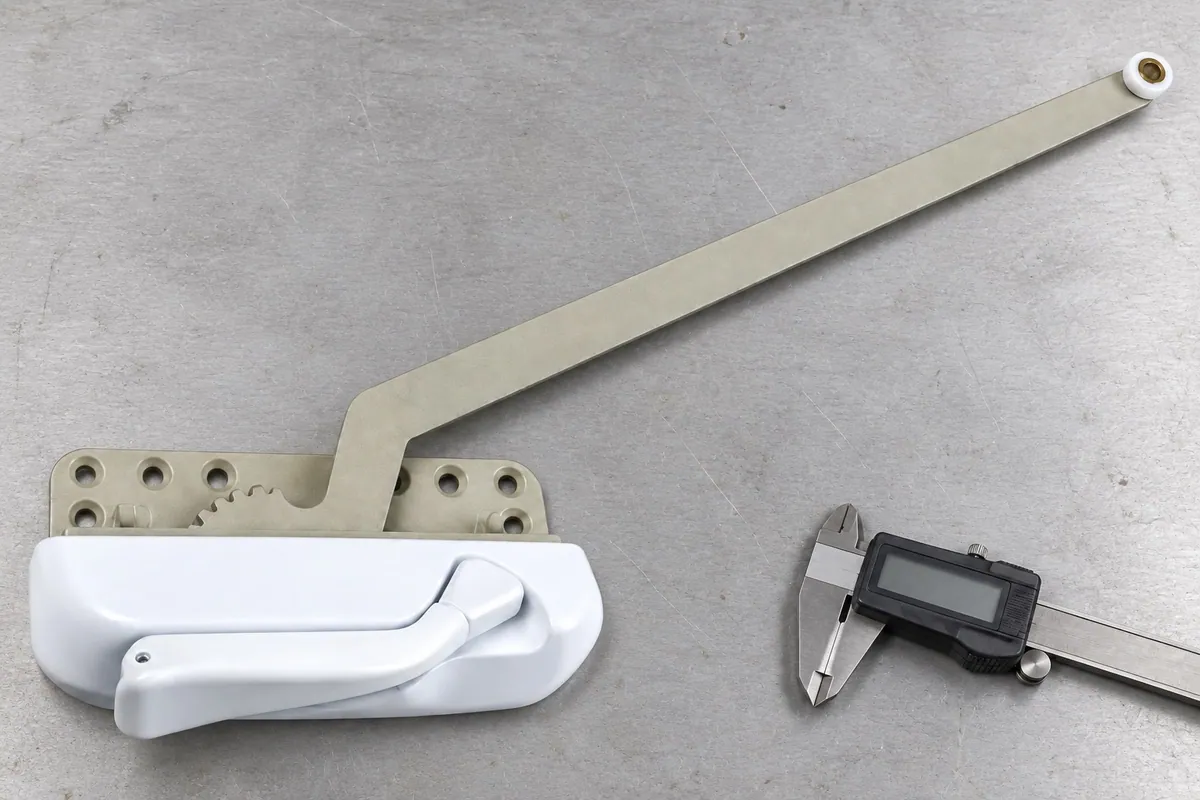
A casement operator turns the rotation of a handle into movement of a sash. Between those two events sit a gearbox, arm joints, a track or bracket, the window hinges and the frame. Resistance experienced at the handle can therefore originate somewhere else in the assembly. Replacing the most visible component may leave the underlying cause untouched.
The useful first distinction is not simply whether the window feels heavy. It is whether the effort is high throughout travel, increases near closing, or spikes at a repeatable position. Those are different observations. Recording when a change began—after glazing, installation, adjustment or a long period of normal service—also gives the observation context. None of these clues alone identifies a defective part.
Why the same window can feel different as it opens
In a simplified lever model, turning effect depends on force multiplied by its perpendicular distance from the pivot. As a linkage moves, the angle and effective lever arm change. A force that produces useful movement at one position can produce much less at another. Real operators add gearing, friction and several interacting pivots, so this principle explains variation rather than providing a universal sizing formula.
This is why checking only fully open and fully closed positions misses important behaviour. An intermediate position can expose interference or an unfavourable relationship between the arm and the sash. A longer hand grip may make the input feel easier, but it does not correct a conflicting movement path or establish that the mechanism is suitable for the window.
The hinge and the operator must agree on the path
The hinge arrangement guides how the sash moves. The operator must drive a compatible path rather than try to impose a different one. Matching fixing centres establishes only that parts can be attached; it does not demonstrate that they can move together without binding.
AmesburyTruth's EntryGard guidance provides a concrete example: compatibility restrictions apply to certain hinge arrangements, and mounting position matters. These are model-specific engineering instructions, not a rule that every operator can use the same hinges. The wider lesson is that apparently minor geometry changes can alter an assembly's behaviour without changing its appearance.
Single-arm and dual-arm are not a quality ladder
AmesburyTruth's Maxim range distinguishes single-arm, dual-arm, dyad and awning applications. The categories describe different configurations, with their own selection limits; they are not interchangeable performance grades.
It is tempting to read two arms as automatically stronger than one. That overlooks what each linkage is intended to do and how its connection points move. Arm count alone says little about the effort needed on a particular sash, available opening, frame clearance or suitability for a particular hinge. A category name helps identify a mechanism; it does not replace its dimensional and application information.
Read the resistance pattern without forcing the window
Resistance throughout travel suggests a different inspection path from resistance appearing only as seals and closing interfaces begin to engage. A catch at the same opening position makes interference or the movement geometry worth examining. These are starting points for investigation, not diagnoses that can be made from a description alone.
Do not use a longer improvised lever, disconnect a loaded sash or keep winding through a hard stop. A supported inspection by a competent technician can separate the condition of the operator from alignment and other moving interfaces. If testing is needed, changes should be made one at a time so the effect of each adjustment remains visible.
Opening, pulling closed and locking are different tasks
An operator may move the sash and bring it towards the frame, while a separate locking system completes another part of the closing sequence. The exact division depends on the window design. Treating the crank as a device that must overcome every closing problem can conceal misalignment or an incorrectly adjusted interface.
The most informative account of a stiff window therefore describes a sequence: when effort rises, which parts are engaging, and what changed before the symptom appeared. That turns an imprecise complaint about a handle into a mechanical question about a complete window. It also explains why a smooth-running sample depends on coordinated geometry, not simply a more substantial gearbox.